

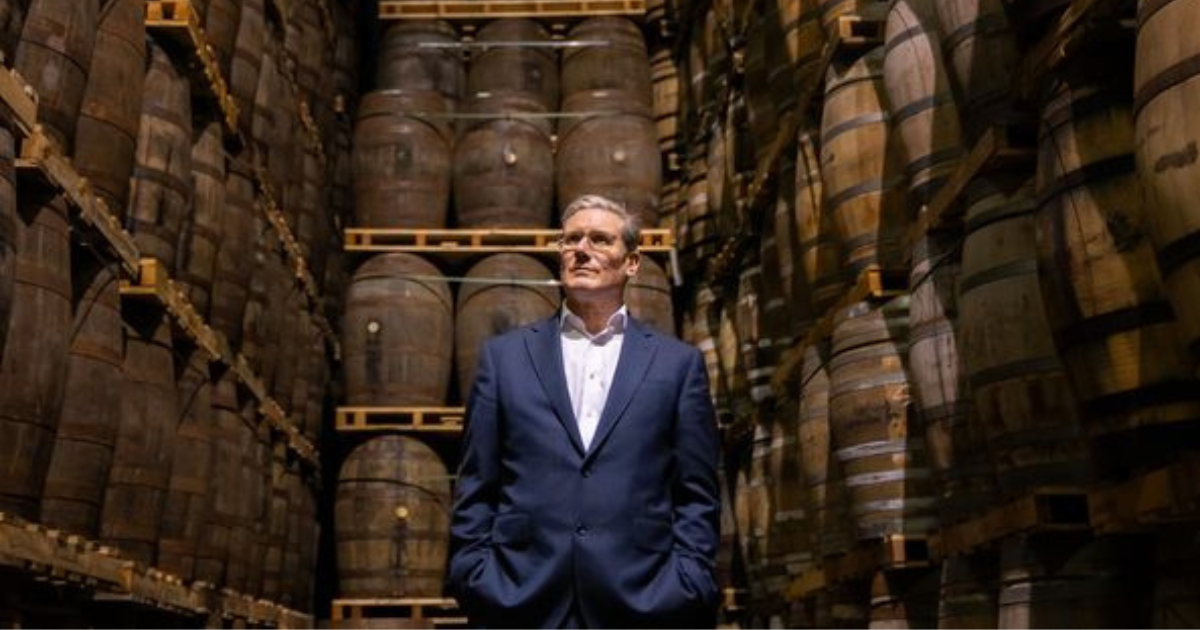
Observant observers of Keir Starmer’s ascent to leadership of the Labour Party, particularly those with lingering doubts about its legitimacy, would likely find the recent investigation by Gabriel Pogrund and Harry Yorke in last weekend’s Sunday Times quite intriguing. Drawing from insights provided by investigative journalist Paul Holden, whose upcoming book “The Fraud: Keir Starmer, Labour Together, and the Crisis of British Democracy” is slated for release early next year, the Sunday Times piece sheds light on a covert fund of undisclosed, unregulated, and illegal dark money—totaling over £730,000—that bankrolled the resurgence of the Labour party under its far-right faction, with Keir Starmer as its public face.
Involvement of Labor
The narrative’s focal point revolves around the involvement of Labour Together—a group characterized as “secretive” by Pogrund and Yorke—in the electoral success of the Labour leader. Labour Together is depicted as having a pivotal role in orchestrating the political resurgence of the Labour right. Their strategy, meticulously crafted, aimed at displacing and ultimately dismantling Corbynism by deceiving the majority of the party membership through the promotion of a politically adaptable but outwardly palatable leadership candidate.
Central to this covert endeavor was Morgan McSweeney, a seasoned bureaucratic operative aligned with the Labour right, who currently serves as Starmer’s most trusted confidant and advisor, tasked with overseeing the upcoming general election campaign.
The formation of Starmer’s leadership, both in terms of strategy and funding, was shrouded in secrecy and carried out in a manner that could be described as dubious. Funds from undisclosed sources circulated through an organization that initially portrayed itself as impartial regarding the party leadership but, as its website now openly admits, was actively working to propel Starmer into a position of power.
As per the Sunday Times report, Morgan McSweeney allegedly neglected to disclose £730,000 in donations from various wealthy businessmen between 2017 and 2020. Additionally, there were instances of misreporting and underreporting of other financial transactions, along with false assurances given to supportive MPs regarding compliance with electoral law.
In 2021, an investigation by the Electoral Commission concluded that Labour Together had committed over 20 separate violations of electoral law, resulting in a significant fine and criticism for failing to provide a valid explanation for their actions. However, by this time, substantial amounts of money, unprecedented in Labour politics, had already influenced the party’s trajectory, paving the way for Starmer’s potential ascent to Downing Street. McSweeney, and consequently Starmer, had managed to avoid direct association with the scandal until now.
Lying as a political strategy
It’s challenging not to admire the calculated ruthlessness with which the Labour Right executed its mission to reclaim control of the party. In this respect, Morgan McSweeney deserves recognition for a keen insight that should have been better understood by the party’s left—a significant failure in political education.
This insight was that the surge of support for Corbynism within Labour was strategically susceptible to a challenge that seemingly embraced aspects of Corbyn’s critique of Blairism and New Labour, such as triangulation, lack of principle, and political complacency, but in reality, aimed to dismantle it.
McSweeney likely learned this lesson through experience, particularly from managing the leadership campaign of the staunch Blairite candidate Liz Kendall in 2015. This campaign, which ended in a humiliating defeat with a mere 4.5% of the vote, served as a stark reminder of the limited appeal of unapologetic centrism at that time.
Politics in Easy Mode
The 2020 Labour leadership election stands as a monumental fraud. It has become increasingly evident that Starmer’s candidacy resembled that of a Manchurian Candidate, a sleeper agent serving interests vastly different from those portrayed at the time. There’s little need to delve into how the notorious ten pledges that formed the basis of Starmer’s leadership campaign have been consistently and thoroughly abandoned.
This is widely acknowledged, with social media flooded with compelling evidence, prompting even occasional mainstream media interviews to question Starmer’s accountability. Starmer’s explanations regarding whether he has breached specific pledges or even made them in the first place fluctuate according to convenience, further eroding trust in his leadership.
It’s a classic scenario of the intricate web spun by a deceitful individual who finds themselves unable to recall the precise falsehoods they’ve concocted. The revelations concerning Labour Together—the undisclosed resources spent on meticulously crafting a platform tailored to appeal to the party’s “soft left” center—strongly imply that this strategy was deliberate from the outset. It appears to be a form of confidence trick purposefully enacted upon the Labour membership.